


Hi, it’s Melissa, Cofounder and CEO of eWebinar. Welcome (back) to “your founder next door“, a weekly publication on the strategies and stories behind building a company without an abundance of resources and friends in high places. No BS, just straight-up truth bombs.
The Big Aha! 💡
This is the story of how I built my company around a “purple ocean” strategy for 6 years thinking that was the holy grail of bootstrapping, only to realize I had been getting it wrong the whole time. What purple ocean really means, why my misunderstanding of it kept us small, and the biggest opportunity most bootstrappers can unlock.
Backstory: PTSD from being first to market 👩🏫
Before eWebinar, I built two startups. Both were blue ocean, meaning we were first to market with products nobody (or very few people) had seen before.
My first company, Flat World Apps, built interactive brochures for real estate development projects on the iPad (which had just come out at the time). Instead of handing homebuyers a coffee-table-book-style brochure, we offered an iPad app where floorplans and photos could be updated in real time, doubling as a sales tool with inventory management.
My second company, Spacio, was an open house check-in system that replaced pen-and-paper sign-in at open houses, which we sold to real estate brokerages to offer to agents as a perk for being part of their company. We collected leads digitally for automated follow up and provided real-time foot traffic data.
Both products were simple concepts that made sense. Both solved problems, though more vitamins than painkillers. Both were nightmares to sell.
Because nobody sold what we were selling before us, every conversation started from scratch. Nobody knew what our products were, so every person had to be educated from the ground up. Our value wasn’t immediately understood, so every prospect had to be convinced. There was no price comparison, so prospects didn’t know if we were too expensive, too cheap, or just right. We weren’t in anyone’s existing budget so every sale was a fight to be an extra line item. Most companies didn’t want to be the first to buy in and saw us as a risky investment. It took 2.5 years before we made our first $10 with Spacio.
👋 Before we continue - If you enjoy this article, would you please consider restacking it and sharing it with your audience?
This spreads the word and keeps me writing content that will inspire founders to keep doing what they’re doing, knowing they’re not alone.
I wrote about the 10 painful lessons from being first to market. That was 10 years of my life across two companies, and neither business grew large enough to become truly exciting. Spacio was eventually acquired (my acquisition story here), but only after years of grinding without clear signs it would ever work out. Those two companies felt like a decade of pushing a giant boulder uphill.

The friend who introduced me to being “second mover” 💡
Before starting a third company, a close friend and one of the savviest founders I know gave me a piece of advice that rewired my approach to business.
He said: “The reason your businesses have been so hard is because you try to be first mover. When you’re first, you have to open up the market and be the first to educate. When you go into an existing market, you can learn everything from existing companies, their successes and failures, and figure out how to do better in every aspect of the business. You don’t need to figure out if your business is viable, consumers are already buying from others. They just need to buy a better product from you. It’s a lot easier to be the best second mover, and you’ll make money right away.”
That friend was Victor Tam, CEO & Cofounder of Monos.com. (Fun fact: He also gave eWebinar its name when I couldn’t come up with anything interesting. A couple days after I told him about my idea to automate webinars as it was the biggest problem I lived with for years at Spacio, I got a text: Buy this domain now, I already negotiated for you. Trust me, it’s cheap.)
For the first time, I understood why both of my previous companies were uphill battles. In under a minute, Victor put everything into perspective. At that moment, I decided that was my past, and it would never again be my future.
I’ll never go blue ocean again.
I deliberately chose a purple ocean strategy for my next company: take a proven business model (red ocean) and introduce it into an untouched market (blue ocean). I found a product category that already existed, automated webinar software, studied what was out there, and set off to build something 10x better for a completely different audience.
The existing players in this space were built for infosales: course creators, life coaches, internet marketers. Their software was clunky, full of deceptive features like fake chat conversations, fake attendee counters, and fake conversion alerts designed to trick consumers into thinking the webinar was live. We didn’t want to be associated with that type of marketing practice.
We envisioned eWebinar to be the best-in-class solution the world’s best brands would be proud to put in front of their customers. We designed it for teams to automate demos, onboarding, and training without sacrificing quality or trust; frustrations I was deeply familiar with.
It took 18 months to build and 89% of trials in the first month converted. We made money from day one. No customer interviews required, no beta needed. After 10 years of soul-crushing blue ocean experiences, this felt like a dream.
Everything was working 🤩
For the first three years, growth was steady month over month. People were signing up every day. SEO was bringing in traffic. We had raving fan customers, companies of all sizes, really smart people loving the product and incorporating it into their workflows. We were collecting incredible customer stories.
We run perfect webinars without the technical problems that plague live sessions.
- Greg Robertson, Cofounder, Proptech
We hit $1M ARR in 36 months and reached profitability while paying everyone on the team a real salary. That had never happened to me before. In a decade of building startups, I had never been in a position where the business was healthy, the team was compensated fairly, and growth was consistent. I documented that entire journey on Season 2 of ProfitLed, our podcast on eWebinar’s journey to $1M ARR. This felt like validation that purple ocean was the answer.
Purple ocean was working exactly the way I hoped it would. We had a solid product, happy customers, and growing revenue. Life was good. I had figured it out! Or so I thought.
Until it wasn’t 📉
About a year and a half ago, our growth rate flattened. SEO, which had been our primary growth engine, stopped delivering the way it used to. AI came along and we lost ranking for most of the keywords we used to dominate. Traffic went down, which was a story most companies shared at the time. Trials dropped 10-20% depending on the month. No matter what we tried, we couldn’t reclaim our previous keyword dominance. We assumed this contributed to the lack of growth.
Strangely, revenue stayed flat through all of it. We’d go down a couple percent, go up a few, go down again, then up...
At the same time, I hit burnout. Not the kind where you’re tired from working too hard, but the kind your soul feels from not knowing whether you have it in you anymore. I wrote about that journey, took some time to work on myself, and scaled back my intensity with the business.
I told myself two stories to explain the plateau: AI was killing our SEO, and my burnout meant I wasn’t as focused as I should have been. Both felt like reasonable explanations. Both made me feel like the situation was temporary and within my control. Revenue staying flat, I told myself, was actually a positive sign. It meant the business and the product were strong enough to hold even without me pushing hard.
Coming back and hitting a wall 🧱
Eight months ago, I came back in full force. I started talking to prospects and customers directly, going to conferences, and hopping on calls. I hadn’t done this since the first 9 months of eWebinar when I was doing founder-led sales. This was unusual for us as eWebinar is a product-led company, not sales-led. No 1-on-1 demos, no sales calls, no live events. That’s how I designed it.
When I started going to people, as opposed to waiting for them to find us, I noticed a disconnect that was impossible to ignore.
Most of the prospects I talked to didn’t immediately understand what eWebinar does, the value we add, and the problem we solve. Even when I showed them customer stories from companies in their own industry, they still had to be convinced. Every conversation required education from the ground up. Sound awfully familiar? It was the same dynamic I experienced in my blue ocean companies.
The people I was talking to were living in the pain of doing the same live webinars over and over, getting 30-40% attendance rates, burning out their teams on repetitive content delivery, and they didn’t see it as pain. They saw it as the norm, their status quo. It was just how things worked for everyone around them. It’s how we do business. How can we solve their problem if they don’t realize they have one?
I also learned something that challenged a core assumption I’d held since founding this company. I always normalized my own pain. When I was at Spacio, doing the repetitive webinars over and over to train customers, I couldn’t imagine anyone else doing the same thing and not feeling exhausted by it. Turns out, some people actually enjoy the inefficiency of presenting live because it gives them purpose and validates their role. They don’t want it replaced because it’s how they create value in their company. This isn’t a product problem. It’s a value perception gap.
I noticed that our existing customers, even the ones having incredible success with us, pigeon-holed themselves into using eWebinar for a single function. A company using us for their sales demo never considered using it for onboarding or training. Vice versa, a team automating onboarding never thought to use it for lead gen. They loved us for one thing, but couldn’t see the bigger picture on their own.
I was stuck. Out of tricks. SEO wasn’t working. Sales conversations were slow and going in circles. It didn’t seem like most people wanted what we were selling, but we had healthy revenue and positive feedback to counter that claim. It was confusing.
From time to time, someone would come along and say, “You have a positioning problem.” I didn’t fully understand what they meant. What the heck is a positioning problem?! Nobody cared enough to expand. What else could an automated webinar be, if not an automated webinar?!
The conversation that flipped my switch 🤯
Then I interviewed Chris Walker for Season 3 of my podcast ProfitLed (listen to the episode here), and our conversation about the power of reframing identity hit me like a giant lightbulb in the face.
He explained how we lock ourselves into identity loops. For example, when we say “I’m a reactive person,” that’s not a description, it’s a definition. Underneath that identity lives a chain reaction of beliefs, emotions, and behaviors that reinforce themselves. Over time, it becomes so automatic that it just feels like us. In this way, we’re literally deciding our future and everything that happens to us becomes a self fulfilling prophecy.
Hours after that conversation, I kept wondering to myself: Where in my life have I locked something into a frame and refused to see it differently?
That’s when it hit me. I had been doing the same thing with my business.
I was so focused on not wanting eWebinar to be a blue ocean product that I locked it into a purple ocean frame and never questioned it. That frame determined every piece of content, every landing page, every conversation. We were only speaking to people who already had context and found us through search, or heard about us and were compelled enough to land on our site. Then I’d get annoyed when people without context didn’t understand us.
If I had accepted eWebinar as a blue ocean company, I would’ve approached our entire sales and marketing strategy differently. All of our content would start from informing people on the pain they have, rather than selling the benefit of a solution they don’t realize they need.
I wrote about this eureka moment in more detail here, The power of reframing your business.
This is the biggest epiphany and breakthrough I’ve had since eWebinar’s inception.
I had gotten this purple ocean thing all wrong.
What purple ocean actually is (and what I got wrong) 🟣
Here’s a refresher on definitions:
Red ocean means competing in an existing, crowded market. Everyone knows the product category exists, like CRMs. Blue ocean means creating new demand in an uncontested market where people aren’t searching for solutions even if they’re problem aware. Purple ocean means taking a proven business model (red ocean) and introducing it to an audience or vertical that’s never seen it before (blue ocean).
For 6 years, I assumed that because similar automated webinar solutions existed for one market (infosales, course creators, coaches), people in every market would have some awareness of the product category and what it does. It’s not brand new, so it’s reasonable that people would have some exposure to it even if they don’t use it, or so I assumed.
I thought if blue ocean meant nobody knows about your product, and red ocean meant everyone knows, then purple ocean meant people know a little bit.
Plot twist: that’s not what purple ocean is.
Turns out, purple ocean isn’t one audience. It’s two audiences in one market. There’s some red ocean (people who already know this type of product are actively searching for it). There’s a LOT of blue ocean (people who have never encountered this category and, for good reason, don’t immediately get it).
Purple ocean is not a single thing. It’s a combination of two things!
The majority of people who encounter eWebinar don’t understand what we do because they’ve never been exposed to our category before. They’re not replacing another solution with ours. They haven’t acknowledged the pain they have, and we haven’t given them information around that. We tell them what eWebinar is as if they should already know they can benefit from it. Even when they’re living in that pain (doing the same live webinars over and over, accepting low attendance rates as normal), it doesn’t register because everyone around them is doing the same thing. People can’t imagine a future different from the present.
When everyone is sick, nobody thinks it’s a disease.
We needed to be educating people on the problem they live with before introducing eWebinar as the solution. This is not what we’ve been doing.
All those people who told me I had a “positioning problem” were right. I just misunderstood what they meant. The problem was never that eWebinar needed to be something else. The product didn’t need to change. It was the communication around introducing it that needed to be repositioned. When people say they don’t get it, that’s not a value gap, that’s a knowledge gap.
I always knew we don’t have product market fit, and now I know why. It’s not because our product doesn’t have a place in the world, it does, proven by the customers we have. We don’t have PMF because we don’t have product messaging fit, which is a core part of product market fit that doesn’t get talked about enough. When your messaging doesn’t land, when people don’t get what you’re selling, it doesn’t matter how good your product is. They won’t try it. When you don’t have PMF, all efforts feel futile and nothing seems to generate a good enough return. The more people you market to, the more people don’t get it. It’s a vicious cycle where everything you do only amplifies what your business is missing.
All this time, I had been talking about purple ocean as if I’m the expert. I spoke about it at conferences. I wrote about it on LinkedIn and Substack. I built my entire company around this philosophy. But I only understood half of it!
Everything made sense in rewind 🔄
Once I saw it, I couldn’t unsee it. Suddenly, every question we never answered, every sign we ignored, every frustration I couldn’t explain, all had the same root cause.
We’ve all seen the technology adoption curve. The first 2.5% are innovators. Then 13.5% are early adopters. If you’re lucky, you cross the chasm to the 34% early majority.
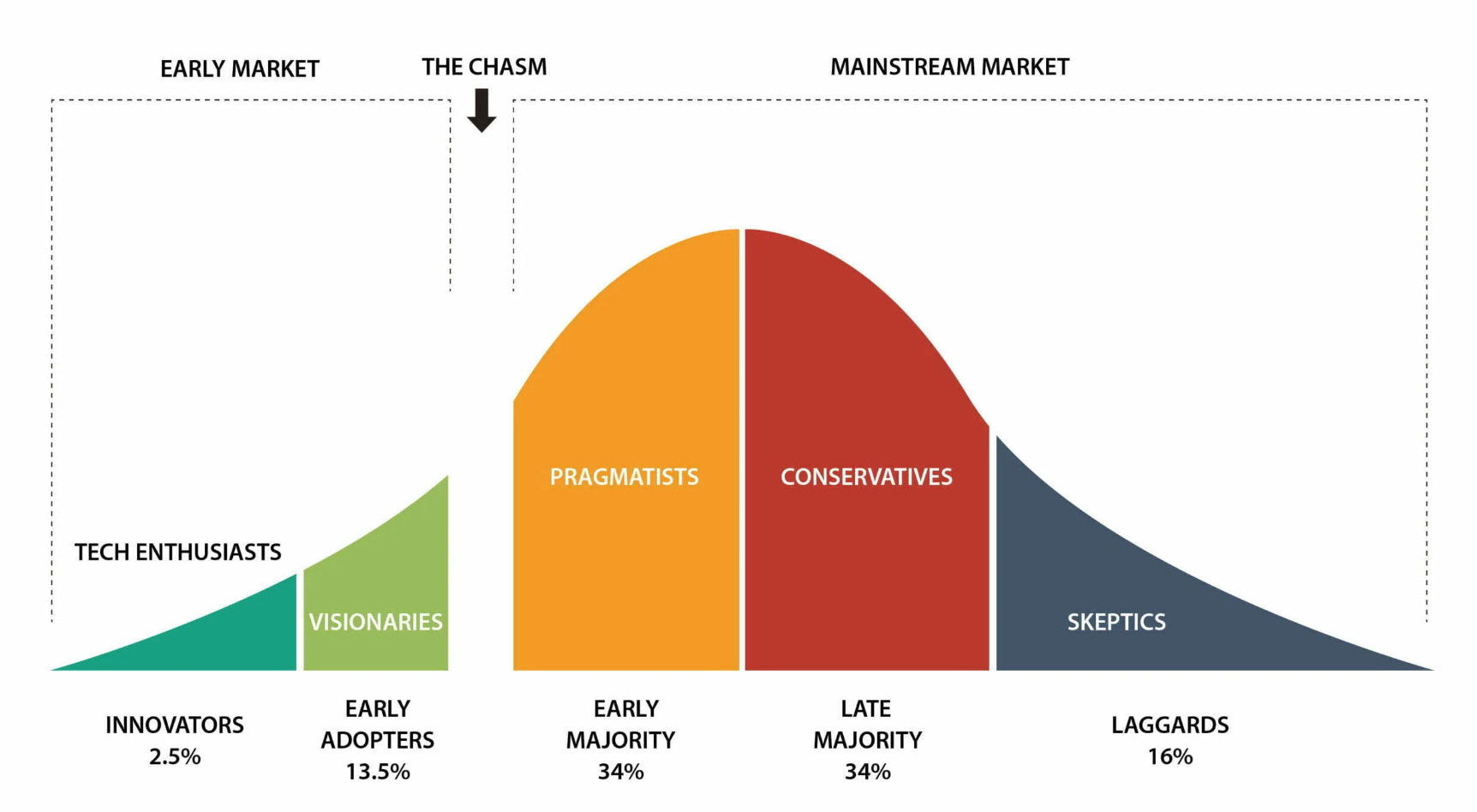
We had been playing almost exclusively within that first 2.5% of innovators; the people actively looking for “automated webinar software” or equivalent. Our entire SEO strategy, our homepage, our messaging, all written for this tiny slice.
This category of software has historically only had penetration in one market: infosales. Course creators, life coaches, internet marketers. That’s why our direct competitors could get away with offering subpar software and still have a good business. The quality expectation of this audience is not high, and they’re incredibly price sensitive. These companies never had to be better because they never tried to reach beyond this audience.
To make things even harder for ourselves, within that 2.5%, we didn’t want all of them. We didn’t want people who were okay with mediocre products, buying on price alone, requiring deceptive features to trick consumers. So our actual addressable slice of that 2.5% was cut in half.
We were writing content to attract a fraction of the smallest segment on the adoption curve, while hoping it would somehow reach the vast majority who aren’t searching.
Looking back, this explains everything.
It explains why SEO seemed to work but never actually grew the business. It accounted for 50-60% of our traffic, so we assumed it was working. We were ranking well, expanding to new topics, doing all the “right” things. Yet no matter how many keywords we targeted or how high we ranked, we were never able to increase the number of trials month over month. That should have been a massive red flag. We questioned why but never found an adequate answer. But things were fine so we ignored it. Our content wasn’t written to educate people who aren’t fully bought in, so we were only speaking to people who already knew what they wanted. We were casting our net in the same small pond over and over.
It explains why our business plateaued. We hit a ceiling within that 2.5% and we weren’t speaking to anyone beyond that. We were trying to target the right people with the wrong language.
It explains why we had initial success. Because all this said, we still played in a bit of red ocean, and those customers got us to profitability.
It explains why our direct competitors are all small businesses. They never figured this out either, so they never grew beyond this pool. Or perhaps they’re fine being where they are.
It explains why every day, people came into our eWebinar demo and asked questions as if they didn’t fully understand what we could do for them. I didn’t think anything of it at the time. They showed up, some converted, some didn’t, life went on. I never stopped to question why so many of them needed so much convincing.
It explains why we can have two companies in the exact same industry, doing the exact same thing, with one company running 100 eWebinars concurrently every day and the other seeing our demo multiple times and still not being convinced they need it. Raving fans and skeptics cut from the exact same cloth, the difference is where they sit on the awareness spectrum.
It explains why even our best customers pigeon-holed themselves into one use case. They didn’t fully understand where else in their organization eWebinar could make an impact, because we never showed them other possibilities.
For years, when people told me they didn’t get what we do, I’d dismiss them. They just don’t get it. It’s so obvious. Eventually, they’ll catch up. Then I’d move on to finding people who already understood. I never stopped to ask why so many people weren’t getting it.
It also explains why the “best practices” in marketing didn’t work for us. We did all the right things: interview your best customers, use their language in your messaging, find more people like them. It barely moved the needle. Because that playbook only works in red ocean.
If you use raving fans to find more raving fans, you’re creating a positive feedback loop of only finding people who already know they need you. That’s the whole point of that exercise, to find more fans like your fans, which it’s perfect for. But you can’t use their language to find people who aren’t fans, and who don’t know they need you. That’s where our biggest opportunity has always been: the market that’s currently completely clueless.
The danger of being “good enough” 😶
We got so many false positives that we thought we were heading in the right direction. Revenue. Happy customers. Success stories. Sign-ups every day. The business was good, and there wasn’t a clear reason to say it wasn’t. So we kept doing what we were doing, not knowing the strategy that got us to profitability was the same strategy that was keeping us small.
This is a dangerous place to be. Good enough to not call it bad. Comfortable enough to stop questioning. We almost accepted that this was as far as we were going to get. This is the easiest place to become complacent, and once that happens, you die slowly. I think this is why every company in our space has stayed small. That’s okay, as long as you’re okay with that. But we are not. I know we are bigger than the tiny market we serve right now.
We were good, but we could’ve been great. The narrative we gave ourselves attached us to an outcome because we wanted it so badly. We wanted purple ocean to be the answer, so we filtered for the evidence that confirmed it and ignored everything that didn’t. In this way, we can design our future, but we can also design our blindfolds.
I was reading The Almanack of Naval Ravikant recently. Naval is the cofounder of AngelList, an early investor in companies like Uber and Twitter. He talks about how the number one thing keeping us from seeing reality is that we have preconceived notions of the way it should be. We convince ourselves that our business is great, so we become blind to the signs that it’s not. We only pay attention to what’s working. We put off reality because we hide it from ourselves. He says to see the truth, you have to let your ego get out of the way. The smaller your ego, the less attachment you have to the outcome you want, the easier it’ll be to see what’s real.
I spent years locked in a conclusion that we were doing fine when we were negligent in so many ways.
I thought I caused our growth to plateau because of my burnout. Now I know that’s not the full picture. I didn’t cause it. We hit a ceiling within the 2.5% we were playing in and the timing just matched up. While I didn’t cause it, I wasn’t in the right mental space to solve hard problems, so I couldn’t identify the situation and get us out of it. The root cause was structural. This distinction is important because it changes the solution. If the problem was me, the fix would be to show up more. If the problem was how we’ve been going to market, the fix required rethinking our entire approach.
The real opportunity in purple ocean 💜
Here’s what I wish I understood 6 years ago.
Purple ocean isn’t a static strategy. It’s a journey with stages.
Your red ocean audience is the people who already know they need what you sell. They give you revenue, validation, and the confidence to keep going. For us, this makes up about 50-60% of our revenue.
Your blue ocean audience is everyone else. The people who have the pain you’re solving, but they don’t feel it because they’ve accepted it as their normal. They don’t know a solution exists. They’re not looking for you. They need to see the problem before they can see the value of your solution. You need to come up with creative ways to get in front of them. For us, this is every company using Zoom to deliver content to their customers; demos, onboarding calls, training sessions, thought leadership… and anyone who uses video to communicate with their audience.
I finally understand that the biggest opportunity in a purple ocean business is to become profitable with your red ocean audience so you can take your time and unlock your blue ocean audience, accessing your total addressable market in a way your competitors never have.
Our red ocean customers kept the lights on. They gave us the runway. Now we get to pursue the other 97.5% of the market on our own terms.
What has to change now 🔧
Everything has to change now. What’s ahead of us is a massive undertaking.
I’m rewriting our homepage from scratch. Instead of assuming people know what webinar automation is, we’re leading with the limitations of live.
To give you an example, compare these two taglines:
Current - Automate 100s of engaging webinars without losing your personal touch.
Future - Live is great. But doing everything live can only get you in front of so many people. It’s limiting your growth. eWebinar fixes that.
Every piece of external-facing content, from our website to onboarding emails to nurturing sequences to blog posts, is being rewritten to educate the reader on the pain they don’t realize they have. Then introduce eWebinar as the solution. Same product. Same value. Different starting point. Instead of going from 1 to 2, we’re going to 0 to 1, then 1 to 2.
We hired a new SEO agency and I’m taking over digital marketing myself, something I avoided for 15 years by telling myself “I’m not a marketer.” (That identity problem again.) That narrative left me feeling powerless and tied to someone else’s performance. Our SEO strategy is expanding beyond “automated webinar” keywords to topics like asynchronous learning and automating product demos, targeting people who aren’t searching for us directly.
With the help of AI, I’m able to produce our own SEO-optimized content alongside our agency, doubling our output without hiring anyone else.
For the first time in a long time, I’m not lost. I’m overwhelmed by the number of things we need to and want to do. There aren’t enough hours in the day. Our team is (re)energized about what this could mean for eWebinar, the company and product we’ve poured our hearts and souls into.
Is this going to work? 🤷♀️
I have no idea.
It’s going to take time. We need to rewrite content piece by piece, develop a new SEO strategy, get our messaging in front of the right people. This is not an overnight fix.
What I can tell you is that this feels right. It feels aligned. Our world feels a lot bigger now. I’ve been at a loss for what else to try for a while. Our market felt limited. Now I don’t see someone who doesn’t understand what we do as “not our customer.” I see them as someone who hasn’t been informed.
That shift has changed how I think about every conversation and every piece of content.
I’ll be sharing everything, every success and failure, as this unfolds.
The biggest lesson I learned through all of this is:
The biggest opportunity in a purple ocean business is to become profitable with your red ocean audience so you can take your time and unlock your blue ocean audience, accessing your total addressable market in a way your competitors never have.
Reflections 🪞
I wish I figured this out earlier. I’m disappointed in myself for not seeing it sooner. I spent years dismissing signs of a struggling business because I wanted to win and didn’t want to fail. I made up excuses to deflect from the hard work I didn’t want to do, like learning marketing instead of outsourcing it.
There was nothing else I could have done to get here faster. I had to have that conversation with Chris Walker, which forced me back to first principles. I had to come out of burnout with fire again. I had to go talk to customers in person and see the disconnect for myself. Every step led to this moment. Hindsight is always 20/20.
What I’m grateful for is we got to profitability, so this isn’t about survival anymore. It’s about expansion. It’s about unleashing the greatest part of our business and the biggest revenue opportunity that nobody in our category has ever been able to crack.
Now that we know how much more there is to explore, I’m excited, I’m energized, and hopefully my insights here can help accelerate another founder out there who’s living in the same situation right now, wondering why things feel stuck when everything looks fine on paper.
If you’re at a place where you have happy customers and revenue but growth has stalled and you can’t figure out why, ask yourself this:
Is the frame I put around my business the thing that’s keeping it small?
The answer might just be the breakthrough you need.
Till next time,
— Melissa, your founder next door ✌️
What did you think of this article? Let me know!
Stuff mentioned in this article 👇
Article: The power of reframing your business
Article: I’m Melissa, here’s my founder story
Article: The only way to live the life you want is to design it
LinkedIn: 8 reasons I went purple ocean
LinkedIn: 10 painful reasons to avoid blue ocean
Book: The Almanack of Naval Ravikant: A Guide to Wealth and Happiness
ProfitLed Podcast - Season 3: Passion, Profit, Purpose, launching soon
👋 If you enjoyed this read, would you please consider restacking it and sharing it with your audience? Forward it to a friend who you think would also enjoy this piece.
This spreads the word and keeps me writing content that will inspire founders to keep doing what they’re doing, knowing they’re not alone. Thank you 💜
It's okay to be 2nd or 3rd in a market. You only need a unique selling proposition, and solve the problems others aren't solving. You're correct, you don't have to tell the same story over and over again, letting people know how your product is used - others have already done that. So, what is your competitive advantage? If you know that and can demonstrate it to the clients, your purple ocean strategy is perfect.
Being first means you have more money invested in R&D and customer education. Being last means you have to be competitive and efficient. Somewhere in the middle is the sweet spot.
As Lee Iacocca used to say, "We don't want to be the biggest, just the best."
Great concept. The biggest wins often come from creating your own category instead of competing in crowded markets. That’s where pricing power and attention live.