


Hi, it’s Melissa, Cofounder and CEO of eWebinar. Welcome (back) to “your founder next door“, a weekly publication on the strategies and stories behind building a company without an abundance of resources and friends in high places. No BS, just straight-up truth bombs.
There’s so much hype out there right now about vibe coding. Anyone can build a product. Developers are no longer needed. Everyone is going to build instead of buy. It’s over for SaaS.
Let me get this straight: A product is not a business.
A product is only a sliver of the entire business. I’d go as far as to say a product is one of the smaller pieces of what makes a business successful.
The idea that anyone can build a product and therefore anyone can build a business is hinged on the assumption that a business is the product. That couldn’t be farther from the truth.
Yes, it’s true that a great product has a bigger chance of succeeding if more people will buy it. But the lack of a product is rarely, if ever, the reason a business fails. There have been plenty of examples of fully built products going to market and failing anyway. Many of these companies even had millions in venture capital and smart people behind them. Remember Google Glass, Vine, and Shyp?
Pete Sena shared this breakdown on LinkedIn of the top 20 reasons startups fail, based on data from CB Insights.
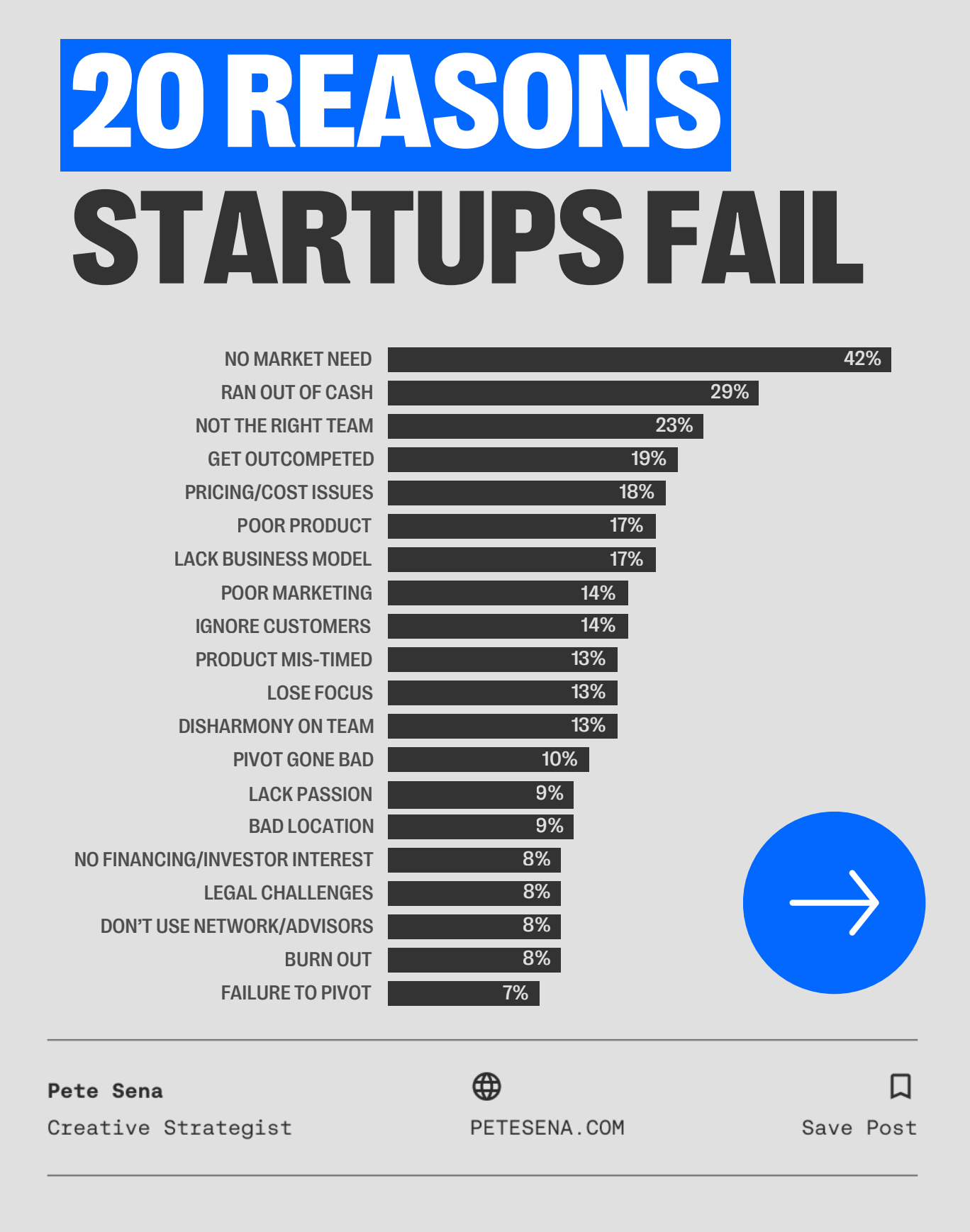
No market need. Ran out of cash. Not the right team. Got outcompeted. Pricing issues. Lack of a business model. Poor marketing. Ignoring customers. Bad timing. Team disharmony. Burnout.
Notice what’s not on that list? “Couldn’t get the product built.”
Most of these are business problems, not product problems. In fact, it’s more likely due to too much product, or the wrong product, that businesses fail.
A product is usually the first thing cofounders discuss before they decide to start working together. It’s the beginning of a story, not the entire one. The success of a business depends on so many things outside of product itself: cofounder alignment, go-to-market strategy, sales, marketing, hiring, retention, firing, operations, capital, revenue, burn, iterations, experimentation, customer happiness, and the most important one of them all... market readiness, something nobody has control over.
Many of these success factors require a dedicated person to manage them. It is incredibly rare, if not impossible, for a startup to be successful without a team behind it.
It’s true that AI has made us more efficient. But it hasn’t taken away the need for a developer. What it’s done is change the role of a developer to also be a product manager.
While AI can make a salesperson’s outreach more effective, someone with sales experience still needs to manage that outreach. While it’s made it faster to write marketing content, it has not eliminated the need for a marketer who understands the intricacies of digital marketing and SEO. While it has increased the speed of launching new products and features, it has not removed the need to understand what the market actually requires. It has not replaced the need to talk to customers and continuously iterate on your product so people will take out their credit cards and keep paying you.
AI has made people more efficient. It has not made teams obsolete.
The idea that anyone can vibe code a product into existence and call it a business is way too simplistic. It completely ignores what a business actually is. A business is a collection of many things that all need to come together and go right, including the product, in order for there to be financial success.
If a business were only dependent on having a great product, we’d all be billionaires and everything would be a lot easier.
The way to make a product successful is not just to build it. The way to make a product successful is to understand every element around it that needs to go right in order to support that product and push it to market so that it has real business viability.
Yes, a startup is not a startup without a product.
But a product is nothing without a business.
Till next time,
— Melissa, your founder next door ✌️
🎧 Speaking of things that make a business successful, listen to my new podcast on Wes Bush’s ProductLed: Signing up isn’t enough - The missing piece to scaling eWebinar beyond $2m

What did you think of this article? Let me know!
👋 If you enjoyed this read, would you please consider restacking it and sharing it with your audience?
This spreads the word and keeps me writing content that will inspire founders to keep doing what they’re doing, knowing they’re not alone.
Thank you 💜 The only way this grows is by word of mouth, so I’d really appreciate all the help you’re willing to give.
If there’s anything specific you want me to write about, hit reply and let me know. I read every message.
CB Insights doesn't list "couldn't build the product" in the top 20 startup failure reasons - and that was before AI made building trivially easy. Your point about direction is the one people skip. I ran 30 nights of autonomous AI builds and got 30 technically functional apps with zero business pull.
The tool works. The brief was missing. A product is nothing without a business, and a business is nothing without someone who knows what they're trying to accomplish. That clarity has to come from the human.
Nobody is selling it and AI can't generate it. https://thoughts.jock.pl/p/directed-ai-experiments-vibe-business
This so such a gem, the deeper I dive into building my startup the more obvious this becomes!