


Hi, it’s Melissa, and welcome (back) to “your founder next door”, a weekly publication with stories and tidbits of my human journey bootstrapping eWebinar to $5m ARR. No BS, just straight-up truth bombs on what it’s like to build a company without an abundance of resources or friends in high places.
The Big Aha! 💡
This piece is about a question I get asked a lot, and why it’s the wrong one. “Should I bootstrap or raise VC?” sounds like a money question. It isn’t. The funding you choose quietly writes the rules for how you’ll spend the next ten years of your life: who you answer to, how you spend your days, whether you can even sell when someone offers to change your life. So before you ask how much you want to raise, you have to ask something harder.
Backstory 👩🏫
A few days ago, I saw a post from Harry Stebbings, the founder of 20VC. If you don’t know Harry, he’s a British investor who started a venture capital podcast from his mom’s kitchen table as a teenager and turned it into one of the biggest media brands in venture, with a $400m fund behind it now. He interviews the founders of Sequoia, Benchmark, OpenAI. He knows a thing or two about how venture capital works and where it’s headed.
His post was titled “The uncomfortable truth that most are not willing to accept.” The gist is that the speed it takes you to get to $1m in revenue doesn’t matter, but the speed from $1m to $10m matters more than ever. If you don’t go from $1m to $10m in two years, you’re no longer a product for venture capital.

I’m not sure how accurate that is. One can only take his word for it. But if that’s where we are, it’s terrifying. (Wtf just happened?)
Side note: There’s something in his post that I disagree with. He’s insinuating that you find product-market fit somewhere between zero and $1m, and that once you hit $1m you’re ready to scale to $10m. Hitting $1m in revenue doesn’t necessarily mean you’ve found PMF, and it doesn’t necessarily mean you’re ready to scale. I wrote about exactly this, and debunked the whole idea of what people think PMF is versus what it actually takes.
The point of his post though, is about how the game works.
When I read posts like that, I don’t feel the anxiety of falling behind. I feel relieved. Because every time I read VC related content, it reassures me that I made the right choice in never hopping on the venture train.
I left a comment, and it became the top comment on his post.
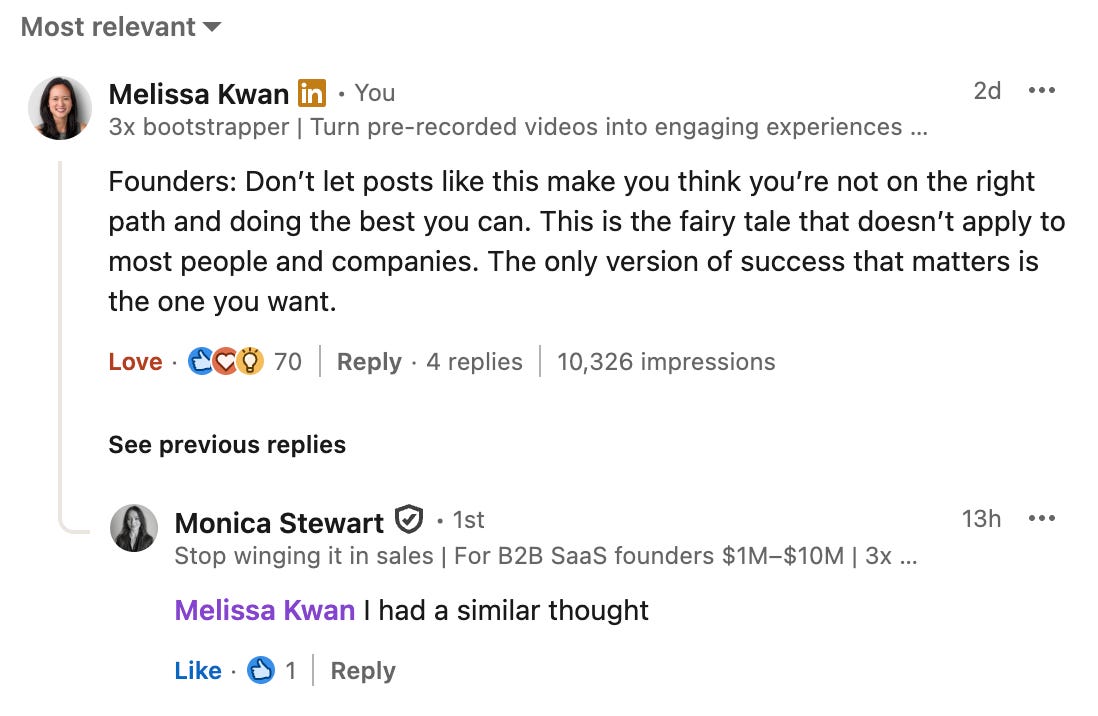
Seems like I struck a nerve and there are many others like me out there.
I’m an avid bootstrapper, but I follow investor content on purpose. Nobody is pushing me to think bigger or asking me the hard questions about where we’re headed. That’s my job, and it’s easy to get comfortable with where things are. Understanding how investors evaluate deals gives me that reality check. Sophisticated investors think about long-term value creation in a way I have to be intentional about because I don’t have that external pressure. Reading their content forces me to step back and ask myself: am I making the right decisions? Am I looking at this business the way I should be? I don’t have to return VC capital, but my goal is still to maximize the return for myself, my cofounder, and my team.
(On that note, whether you’re raising or not, you should read this guide from Susan Montogomery (Susan | Angel Investor). Susan backed 13 unicorns at pre-seed and seed, and she gives you a window into what it’s like on the other side of the table. It’s the most comprehensive, thoughtful, and informative guide to raising capital I’ve ever seen. It’s exactly the context I wish I’d had when I started my first company 15 years ago, and my second one too.)
Harry’s post reminds me of my own story that I tell a lot. It’s as relevant today as it was 10 years ago. I’ve written about how I went from chasing unicorns to bootstrapping. It’s the most popular article I’ve ever published. The short version: I moved from Vancouver to New York, watched all my peers raise money, tried to do the same, and nobody would fund me. After a couple years of struggling and a lot of rejection, we became profitable and I no longer needed someone else’s permission to exist. Best thing that ever happened to me.
The thing I want to talk about today is something I’ve come to believe deeply.
Contrary to what everyone seems to think, funding is not a financial decision. It’s a lifestyle choice.
👋 Before we continue - If you enjoy this article, would you please consider restacking it and sharing it with your audience?
This spreads the word and keeps me writing content that will inspire founders to keep doing what they’re doing, knowing they’re not alone.
The question I get asked a lot 🤚
“Should I bootstrap or should I raise VC?”
I get this question all the time. It’s the wrong question to ask. It shows how little the person understands about building startups, and about themselves.
The choice isn’t really about money. Whether you raise venture capital or bootstrap, that single decision determines your entire business model. And your business model determines your life.
Let me explain.
What happens when you raise VC 🎢
When you raise venture capital, you sign up to keep a growth rate. That growth rate determines the fate of your next round, and the one after that, and the one after that.
It stays that way until one of two things happens: you have a liquidity event, or you can no longer raise. If you can’t raise, you either shut down, or you turn the company into a self-sustaining business funded by customer revenue.
That’s the game. Nobody escapes it. You won’t be the exception. The classic benchmark is T2D3: triple, triple, double, double, double. It sounds like a Tim Horton’s coffee, but it’s actually much harder to swallow than that. It means you triple revenue two years in a row, then double it three years in a row. Coined by investor Neeraj Agrawal, it describes the hyper-growth path a startup is “supposed” to take to reach $100m in ARR and a $1B valuation within five to six years. That’s the bar for venture capital. That growth rate determines whether you can raise, and raising determines whether your company survives. You’re not raising because you want to. You’re raising because if you don’t, the company dies, everyone loses their job, and you walk away a failure. (Though, can you really fail if you tried?)
Keeping up with that growth means finding revenue, or some equivalent metric like user base, sometimes before you’ve even found true product-market fit. Sometimes it means growing at any expense. Sacrificing what customers actually need in order to move fast. Buying revenue through ads and PR. Telling a public story about your company that builds a facade impressive enough to get you to the next round.
Sometimes, that model pushes founders to do bad things. Take the most recent story about Delve, a Y-Combinator startup that raised a $32m round and was later accused by a whistleblower of faking its compliance work. Delve denies the allegations, but the fallout has been real: YC cut ties and customers fled. We’ve seen the fully ripe versions of this kind of story before too. Remember FTX? Or Frank? These aren’t just stories about founders who lacked integrity and thought they could outsmart the law and outrun their own deception. They’re byproducts of a system that rewards the appearance of growth above almost everything else.
VC-backed companies are revenue driven, which is not to be confused with profit. Profit is what’s left over after revenue covers costs. Most venture-backed companies are chasing the first and burning through the second. They don’t need to be profitable, they need to show growth.
My friend Zvi Band put it to me perfectly once: once you get on the venture train, you can’t get off. Zvi raised VC to build Contactually (CRM), had a good exit a few years back, and every company he’s started since then he started as a practical founder, bootstrapped. We talked about his experience in the first season of ProfitLed, including how one of the real costs of raising venture capital, for him, was his mental health. The pressure of that train doesn’t just shape your company. It wears on you.
My friend Lloyed Lobo (follow him on Instagram where he shares founder content daily) and I did a whole episode on this on our other podcast, UnicornPrn, called “Venture Capital is a Giant Ponzi Scheme.” It’s a spicy one. We get into how the markup game actually works, why founders end up owning so little of what they built, and why a $1B valuation on paper can become a zombie company in real life. Worth a listen if you want to understand the machine before you decide to step into it.
What happens when you bootstrap 🥾
When you bootstrap, there are no set rules. You don’t adhere to a model. You don’t have a board that needs to approve your major hiring decisions or sign off on whether you can accept an acquisition offer. You don’t have institutional investors at your back, pushing you to grow so their stake gets more valuable and their money stays safe.
I say institutional investors because bootstrapping doesn’t mean zero funding, contrary to popular belief. It means no institutional funding. Most bootstrapped companies have some money behind them. It can come from the founders themselves, from friends and family, from family offices and angels, government grants, business loans, crowdfunding, or non-dilutive revenue-based funding like Capchase. (Todd, our COO, and I went deep on all the different ways to fund a bootstrapped company in this episode of ProfitLed on Season Two, if you want the full breakdown.)
The difference is that non-institutional investors don’t impose requirements. They don’t get a board seat. The rounds are usually small. It’s typically a passion-project kind of investment, where someone believes in the founder and wants to support them.
When your growth rate isn’t set on someone else’s timeline, your whole business model changes.
A bootstrapped company’s objective becomes getting to profitability as fast as possible, so the business can sustain itself.
Focusing on profitability means optimizing two things: burn, by hiring as little as possible, and revenue, by creating so much value that customers can’t live without your product. It’s the opposite of a VC-backed company, which usually wants to hire as fast as possible to manufacture more growth. The day your revenue equals your burn, you have a forever company. You no longer depend on third parties to survive.
VC-backed companies are revenue driven. Bootstrapped companies are profit-led.
That distinction is the reason I started my podcast, ProfitLed, these are things that don’t get the spotlight it deserves. Season three, the intersection of Passion, Profit, and Purpose, is now live, with a new episode every second Wednesday. If you want real conversations with founders building real businesses, come and tune in. Here’s the backstory of this season’s theme:
Two companies, two completely different lives 🎭
These two kinds of companies are fundamentally different because their priorities are fundamentally different. One is investor driven. The other is customer driven. Running each one hands you a completely different life.
At a VC company, you have a board. People other than you and your cofounder who hold decision-making power over the company. Depending on your funding terms, you’ll need their approval for all kinds of things: your annual budget, executive hires and fires, issuing new shares, taking on debt, and yes, whether you’re even allowed to sell the company and accept an acquirer’s offer.
Here’s a personal story that makes the last point real. I sold my last startup, Spacio. Had I raised VC for it, I certainly wouldn’t have been able to sell it for the price I was offered, because that price would’ve been too low for venture-style returns. If I hadn’t been able to sell Spacio, I wouldn’t have had the capital to start eWebinar two months later. Which means I wouldn’t have gotten another shot at the life I actually wanted, the one I finally have right now.
I can’t even imagine working for years toward freedom, finally getting a life-changing offer, and having someone who never worked a single day in my business refuse it on my behalf because they wanted higher returns. Disregarding my wishes, my life, my future, for a number on their spreadsheet.
I’ve heard so many of these stories. A VC-backed founder gets an offer that would make them financially free, sometimes a retirement-level exit. The VCs rejected it because they thought it was worth more. The market shifts, the company dies, and the founders walk away with nothing. They were close, but the decision was not theirs to make. I’ve heard the same thing from a few friends. They haven’t yet found another opportunity like that, and never fully recovered from the shoulda woulda shoulda.
The scenario keeps playing out. Hiring people means managing people. If that’s not your thing, and it is definitely not my thing, you’d better make it your thing fast. Your investors will probably want you to have an office. It’s not about the office itself, it’s about dedication, focus, and being physically together with your team all the time so you can move faster. Growing revenue might mean going upmarket into enterprise before you’re ready, or when you don’t even want to. Except it doesn’t matter what you want, because that’s the path you’re on. You need the revenue. Going upmarket means endless one-on-one sales calls, hiring salespeople, going to conferences and doing the whole dog and pony show, hiring customer success managers, and being there in person. That’s a whole different kind of company. If you dreamed of being a digital nomad like me, you can kiss that goodbye.
That’s just part of the story. Use your imagination for everything else you might have to do to pump revenue. The point is, everything happens on a timeline set by your burn. Because the time it takes to raise your next round depends on how the business is doing, you should be out raising six to twelve months ahead of when you actually need the money. Which means you’re always raising. You’re always putting on a show to make it look like you’re “killing it” (more cringe startup-speak). Every raise pulls you away from operating your company and serving your customers. You end up running a company that has the added stress of managing investor expectations.
I’m not saying VC is a trap, I’m just naming some of the shortcomings that founders don’t realize come with capital. There’s no free money. Some founders have a big idea, and they know exactly what it takes. They’ve proven themselves and their business, they’ve found PMF, and they’re ready to scale. They thrive off building this kind of company. They live and breathe it, it’s in their blood. Those are the people who should absolutely go for the raise.
A business designed around a life 🏖️
Bootstrapped companies set their own rules. Let me use mine as an example since it’s the one I know best.
Before I started eWebinar, I made a list of 10 non-negotiables I had to have in order to be happy. I wrote them all down here. Then I intentionally chose a business to fit the lifestyle I’d been dreaming about since the day I walked out of my cubicle at SAP 15 years ago.
This is what eWebinar looks like today.
We’re a small team. Everyone is remote. Everyone is a contractor. We only hire when it’s absolutely necessary. We have zero meetings. Everyone self-manages and is self-motivated. Anything goes, as long as the customer comes first.
We don’t offer phone support. We can’t afford it and we don’t want it, because freedom matters to us more than almost anything. We focus on delivering ROI for our customers so they stay. We have no money for ads or PR, so instead we make sure every request gets heard, every detail gets built on, and we try to predict what customers need before they even ask. We have to.
As a result, we move slowly. Our growth rate matters, but only as much as it matters to us. We take the time to learn, so that when we build something, it’s intentional and thoughtful. In 2025 I had a burnout year and stepped back to focus on myself. That is something I could never have done if I’d been responsible for raising the next round. I would have had to either step down or push harder, and pushing harder would have just delayed the burnout and made it so much worse when it finally hit.
My cofounder, who also happens to be my life partner, and I have a lifestyle people wish for. We have it because the company is bootstrapped. We’re the couple who show up to everything, because our schedule is 100% self-directed. We work as much as we want, when we want, at a pace that fits our lives. All of it is possible because we have a small team that doesn’t need managing, no salespeople, and we don’t do live events.
The only way to have the life you want is to design it.
Our business model, self-served with no calls, determined our lifestyle. We make product decisions based on our happiness, and sometimes, we trade revenue opportunities for it. Nobody tells us we can’t do it.
The model of every VC-backed company looks more or less the same. Every bootstrapped company, though, is a snowflake. Each one is unique, shaped entirely around the life its founder wanted to live.
I’m not romanticizing bootstrapping because it has real costs. I’ve lived through them.
Bootstrappers struggle more in the beginning because it’s harder to get a company off the ground without resources. It sucks for a long time, until it doesn’t. Everything is really frikken hard. I didn’t get a real salary until my last startup was acquired, nine years into my founder journey, when I started working for my acquirer. Then I didn’t pay myself for the first four years of eWebinar, until everyone else was paid first.
I still carry some of that PTSD from my past life. To this day, I look at the prices on a menu before I decide what to order.
What I believe is that bootstrapping is harder up front and less stressful in the long run, once you hit profitability. The day your revenue covers your burn, the weight lifts. VC, in some ways, is the opposite: the money makes the early days easier, and the pressure compounds from there with your need to grow.
The real question to ask yourself 🧭
The real question is not “what kind of funding should I go for?”
It’s this:
What kind of life do I want to lead?
This is the same thing Marc Randolph, the cofounder of Netflix, wrote about recently, when he talked about founder-model fit. A founder he was mentoring sent him an email asking whether choosing a slower, more sustainable path made her less ambitious. Whether she was just talking herself into a “lifestyle business” because she couldn’t hack the big leagues.
He said everyone obsesses over product-market fit, and almost nobody talks about founder-model fit. It’s the same idea I’m talking about here. If the way your company is built to grow doesn’t match the way you’re built to operate, you’ll spend every day fighting yourself. And you’ll lose. The question isn’t whether you can handle the rocket ship. The question is whether you want to.
When I commented on Marc’s piece, he replied that he’s been fighting against the “startup fairy tale” his entire career. Which made me smile, because Marc helped build one of the biggest startup fairy tales people chase. How ironic.

Here’s an exercise. Describe a day in your dream life. Where you wake up, what you’re doing, and how you’re doing it. Then work backwards and ask what kind of business could actually give you that.
Keep in mind, whatever you’re building, don’t assume it’ll be “just a few years.” Assume it’s the next ten, because chances are that’s how long it’ll take.
Great companies are built in decades, not years.
All that UnicornPrn you see on your feed, the company going from zero to $100m in a year, that probably won’t be you. That’s okay. Plan for the majority of cases, not the outlier. If you are going to be the outlier, you’re probably not even reading this. You’re too busy executing and carving your own path.
Sometimes you can’t know until you try 🎲
Sometimes it’s impossible to know which path is right for you until you’ve tried one.
I’ve known founders who are addicted to raising VC. They’ll never build a business without.
I’ve known founders who raised VC and vowed never to do it again, even after a good exit.
I’ve known founders who never raised but got a glimpse of that world (like me) and knew it was not the life they wanted.
I’ve known founders who bootstrapped until their business was venture-scalable and then sold the majority to private equity, like Lloyed Lobo did with Boast.ai.
I’ve known founders who never raised, ran successful businesses for years, and now want to shoot for the moon because they feel ready. Or whatever the reason is.
Building a business is self-development masked as capitalism. Along the way, you learn more about yourself, what you want and what you don’t want, so you can make a better choice the next time around. Nobody ever lost from trying.
Be careful what you consume 📱
⚠️ Warning: Be careful about the content you consume. Social media is distracting, and it can convince you that you’re a loser, that you’re standing still, that you’re failing, when none of that is true.
You don’t know what’s real. You never get the backstory, only so much fits in a post. Founders are often putting on that dog and pony show for investors, so half of what looks like “killing it” is theater. The truth is, just by trying, you’re already winning.
Only about 1% of startups are venture backed. That means roughly 99% are bootstrapped. Maybe not 100% founder-funded, but close, led by practical founders building real businesses. You are far more normal than the internet makes you feel. It’s just that the media only reports on the 1% of the 1%, and that completely warps our idea of what success looks like.
The only version of success that matters is yours.
Your happiness matters more than a number. Though it was never one or the other. It’s all of it coming together in harmony, so you can build a company, enjoy your journey, and create a life that’s worth living.
The biggest lesson I learned through all of this is:
Funding is not a financial decision, it’s a lifestyle choice.
Reflections 🪞
There’s nothing wrong with either model. There’s no such thing as right or wrong in business. But I do believe there’s a right model for you. It’s worth figuring out which one that is because it’s your time, the most valuable asset we own.
Both games are good games, if it’s what makes you happy. As Greg Head, the founder of Practical Founders, likes to say, the first rule is to know which game you’re playing.
If what you want and what the money requires of you are misaligned, you’ll be miserable the entire way to finding success. More often than not, you’ll fail or give up before you ever get there. Not for lack of talent. For lack of fit.
Be honest with yourself about the future you want. Get really specific about it. Then choose the funding that builds that life, not the one that looks most impressive on a stage or in a headline.
Money is never the point. Life is.
Till next time,
— Melissa, your founder next door ✌️
What did you think of this article? Let me know!
Stuff mentioned in this article 👇
Harry Stebbings’ post on the “uncomfortable truth” about VC growth speed (and my top comment on it).
What people think PMF is – why hitting $1m in revenue doesn’t mean you’ve found product-market fit.
Susan Montgomery: Count down with me from 100 pitches – the best guide to raising capital I’ve ever read.
How I went from chasing unicorns to bootstrapping – my personal story, and the most-read piece I’ve ever written.
T2D3 explained – the triple-triple-double-double-double growth framework.
The unraveling of Delve – TechCrunch’s reporting on the compliance startup, from the first allegations to YC cutting ties and customers fleeing.
ProfitLed S1: Building a venture-backed startup with Zvi Band – on the real costs of the venture train, including mental health.
UnicornPrn: Venture Capital is a Giant Ponzi Scheme – the episode Lloyed Lobo and I did on how the venture game really works.
ProfitLed S2: Why bootstrapping over VC funding – the many ways to actually fund a bootstrapped company.
ProfitLed is back for Season 3 – new episodes every second Wednesday.
My 10 non-negotiables for life design – the list I made before building a business to fit the life I wanted.
Marc Randolph: Are You Built for the Rocket Ship? – on founder-model fit and not running someone else’s race.
My two viral LinkedIn posts on bootstrapping: the8 biggest misconceptions about bootstrappers and the9 unconventional things I can live by because we’re bootstrapped.
👋 If you enjoyed this read, would you please consider restacking it and sharing it with your audience? Forward it to a friend who you think would also enjoy this piece.
This spreads the word and keeps me writing content that will inspire founders to keep doing what they’re doing, knowing they’re not alone. Thank you 💜
The lifestyle choice part is real because the money changes what you’re allowed to want.
You can start out building for freedom, then wake up working towards someone else’s return.